




Finternet: The Future of Finance Explained Like You’re 10 (Well, Almost!)
- December 10, 2024
- by
- Nishant
At the recently concluded Global Fintech Fest in Mumbai, Nandan Nilekani introduced an exciting new concept: Finternet. This revolutionary idea could transform the financial world, making it more efficient and user-centric. By leveraging cutting-edge technology, Finternet envisions a future where financial institutions, users, and businesses operate seamlessly, allowing users to control how their financial instruments interact for maximum benefit.
While it may sound futuristic or even far-fetched today, remember how the Unified Payments Interface (UPI), Account Aggregator (AA), and Beckn Protocol (powering ONDC) started. Each of these took years to become mainstream. Similarly, Finternet could redefine global finance in the next decade, despite seeming exoteric now. Already, blockchain enthusiasts are discussing it, and meetups are being arranged to explore its potential.
In this blog, I’ll break down the concept of Finternet, explain why it’s a game-changer, and explore how it could power the next generation of Digital Public Infrastructure (DPI).
What is Finternet?
At its core, Finternet aims to create a Unified Financial Ecosystem that integrates multiple financial players and instruments, allowing real-time, transparent, and seamless transactions. Finternet’s two key building blocks are:
- Unified Ledger: A single, synchronized ledger where all financial entities (banks, brokers, regulators, etc.) can interact efficiently for a user.
- Blockchain Technology: Using cryptography to ensure secure, real-time, and decentralized operations.
Why Finternet Matters
Finternet could revolutionize finance by:
- Making Financial Systems More Efficient: Reducing the cost and time for transactions.
- Empowering Users: Placing users at the center, enabling them to mix and match financial instruments (e.g., insurance, pension, real estate).
- Fostering Global Connectivity: Enabling seamless cross-border transactions and collaborations.
Breaking it Down with Examples
Let’s explore Finternet’s potential through real-world scenarios:
Case 1: Transferring Money (P2P Transfers)
Today: If A transfers money from Bank X to B’s Bank Y, UPI simplifies it. However, even with UPI, these transactions rely on intermediaries, and delays in certain cases.
With Finternet: Unified ledgers make transactions synchronous, allowing instant updates for all parties, eliminating delays, and reducing costs.
Case 2: Buying and Selling Shares
Today: A sells shares via Broker 1, and B buys them via Broker 2. The process involves multiple steps:
- A and B’s brokers confirm and transfer the shares.
- Money moves through brokers after deducting commissions.
With Finternet: A unified ledger allows direct interaction among all parties. A’s shares move to B instantly, while B’s payment reaches A without current intermediary delays.
Case 3: Complex Transactions (Shares to Real Estate)
Today: A sells shares, waits for the proceeds, and then uses the money to buy real estate. This process takes weeks, involving banks, brokers, and regulators.
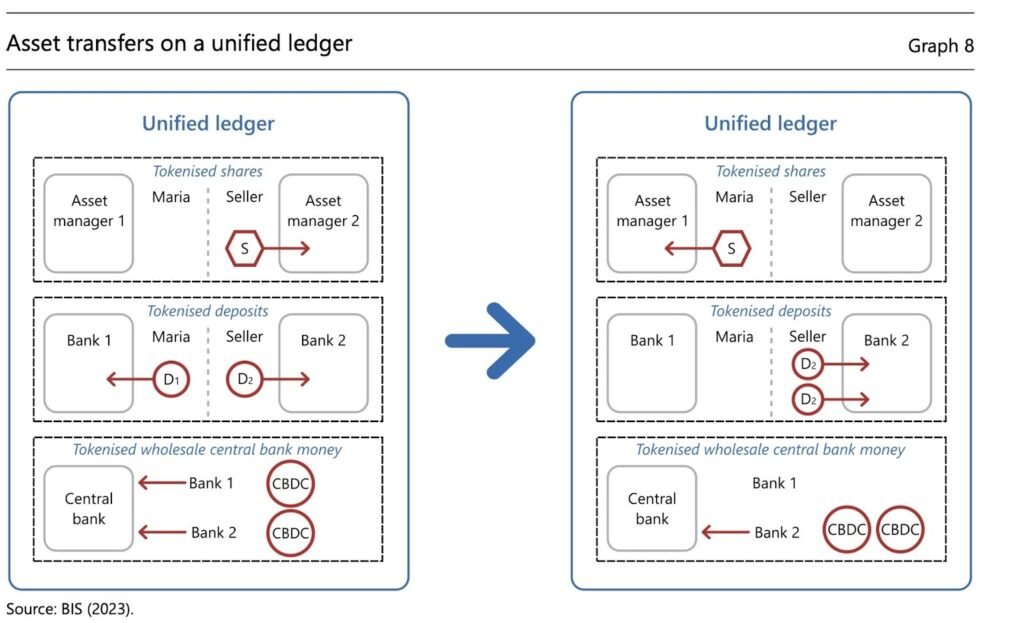
With Finternet: A unified ledger allows shares, real estate, and financial instruments to coexist. A can sell shares, receive proceeds instantly, and purchase real estate—all within minutes. Regulators and stakeholders are synchronized, ensuring compliance in real-time. (see image 2 below)
Finternet’s Game-Changing Potential
Finternet could revolutionize global finance by addressing four key issues in today’s systems:
- Speed: Current financial processes are too slow.
- Costs: Transactions often incur high fees.
- Access: Financial products and services are limited for many users.
- Limited global collaboration: While the internet is a global commodity, finance is not yet or in a very limited way.
How Finternet Solves These Problems
- Efficiency: Reduces costs and transaction time.
- User-Centric Design: Users can execute complex transactions, mixing financial instruments seamlessly.
- Global Reach: Simplifies cross-border transactions, making global trade more accessible.
What Would It Take?
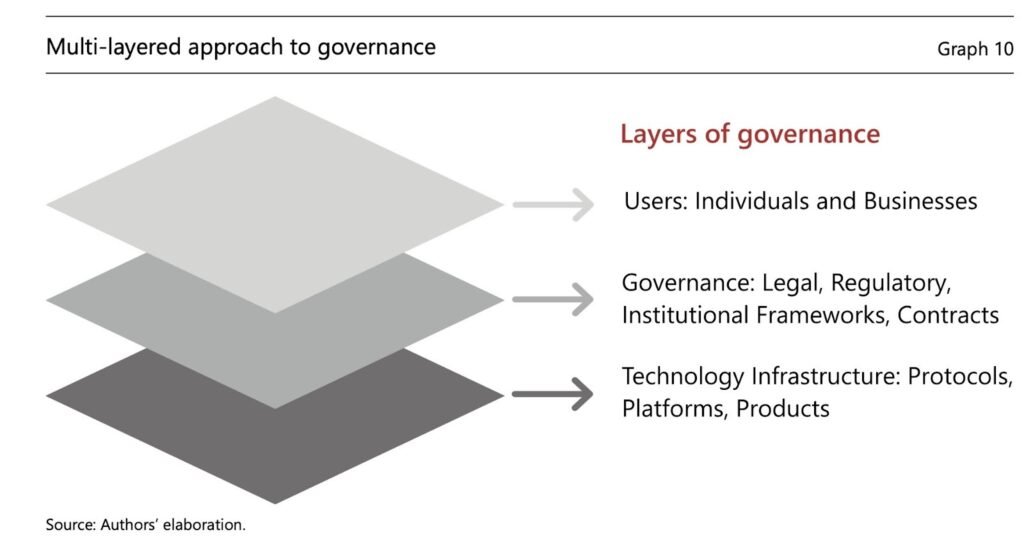
The technology for Finternet already exists, but it requires new layers of enablers and governance structures (see image 1 below)
- Technology Enablers:
- Unified ledgers.
- Advanced blockchain frameworks.
- Scalable infrastructure.
- Governance Models (see image 3)
- Collaborative frameworks involving multiple regulators.
- Cross-border agreements to harmonize financial laws.
- A new batch of intermediaries to validate physical assets before it comes on finternet like attestors, verifiers.
The Power of Tokenization
Tokenization is key to Finternet’s potential. It combines all transaction elements—financial assets, ownership records, and rules—on a single ledger. This innovation enables:
- Smart Contracts: Automated, pre-programmed transactions reduce counterparty risks.
- Atomic Settlement: Synchronous, risk-free settlement of complex transactions.
- Composability: Bundling multiple transactions into one executable package.
- By simplifying asset trading, tokenization enables faster services, lower costs, and greater choice.
Challenges Ahead
- Legacy Systems: Transitioning from existing systems to a unified ledger will be complex.
- Cross-Country Adoption: Differing regulatory frameworks and technological readiness could hinder global adoption.
- Trust and Security: Ensuring all stakeholders trust the system and that data remains secure.
Is Finternet Possible?
Looking at the success of DPI initiatives like UPI and Account Aggregator, Finternet’s vision is achievable. These frameworks took a decade to mature, integrating technology, governance, and user-centric designs. Similarly, Finternet could follow this trajectory with adequate support and global collaboration. With AI becoming more robust and contextual, it will add another important layer in realising the potential of finternet proving an important building block for both suppliers and customers.
“Through local DPIs, we are making a very beautiful garden, beautiful but local, internet can allow that to become a global phenomena”- Promod Varma during SamVAAd (a conclave on AA) 2024.
Conclusion
Finternet holds the promise of reshaping the financial world—making it efficient, user-driven, and globally connected. While challenges exist, the potential benefits far outweigh the hurdles. If realized, Finternet could power the next wave of Digital Public Infrastructure and redefine how we interact with financial products.
The future of finance might just be closer than we think.
Source: Finternet: Financial Ecosystem for the Future
Below images have been taken from Finternet: Financial Ecosystem for the Future, a whitepaper which has been authored by Nandan Nilekani and Agustín Carstens
You may also Like